hort answer: no. There is no good evidence that liver cleanses, detox teas, or “flush” kits remove toxins or improve how your liver works, and major medical institutions including Johns Hopkins do not recommend them1. The reason is simpler than the marketing admits: your liver is already your body's detox system. It does not need to be cleaned out, and no capsule or tea can do that job for it.
That idea is the whole reason Holsom exists, so let us walk through it properly, including what your liver is actually doing when it “detoxes,” why that process cannot be bought in a bottle, and what genuinely supports it.
What “detox” actually means, and why the marketing gets it backwards
Your liver is the body's primary filtration system. It converts toxins into waste products, cleanses your blood, and metabolizes nutrients and medications. Johns Hopkins describes it as fundamental to the body's overall regulation1.
Detoxification is not a service you buy. It is a process your liver runs continuously, on its own, whether or not you are thinking about it. So “detox your liver” has the relationship upside down. Your liver is the thing doing the detoxing. It is the filter, not the thing that needs filtering.
Once you see that, the entire premise of a cleanse falls apart. You cannot flush out an organ whose job is flushing.
How your liver actually detoxes (the part the tea companies skip)
Here is what is genuinely happening, and it is more impressive than any cleanse claim.
Your liver neutralizes harmful substances in a multi-step process. In simple terms:
- Phase 1. A family of enzymes called cytochrome P450 intercepts fat-soluble toxins, things like alcohol and caffeine, and breaks them down into intermediate compounds. Interestingly, these intermediates are sometimes more reactive than the original substance, which is why the next step is essential.
- Phase 2. The liver then attaches small molecules, such as glutathione, sulfate, and amino acids, to those intermediates. This neutralizes them and makes them water-soluble, so the body can actually get rid of them.
- Phase 3. The now water-soluble compounds are transported out, leaving the body through bile into the intestines, or through the blood to the kidneys and out in urine.
Two things matter here. First, this is a coordinated biological system, not a tank that fills up with sludge and needs draining. Second, when people say they want to “detox,” what they are really describing is supporting this system and reducing the load of stuff the liver has to process. And you cannot pour that system into a teabag.
Where liver cleanses came from, and why they persist
If cleanses do not work, why are they everywhere?
Because “flush out your toxins this weekend” is far easier to sell than “your body already handles this, slowly, on its own.” A dramatic before-and-after story sells better than an accurate one.
A 2026 analysis in The American Journal of Gastroenterology looked at the 20 best-selling liver cleanse supplements online. Together they generated roughly $38.8 million a year, with nearly all of them promising to detox or cleanse the liver, and the majority claiming to improve liver function. When the researchers examined the actual evidence behind those claims, they found it limited and inconclusive2.
Johns Hopkins hepatologists are just as direct. Liver cleanses are not recommended, because they are not FDA regulated, they lack clinical evidence, and they do not reverse damage from overeating or drinking1. It is a large, profitable business built on a promise the science does not support.
Some detox products are not just useless, they carry risk
This is worth knowing before you buy anything with “detox” on the label.
Many liver detox products are also marketed for weight loss, and Johns Hopkins advises caution because some supplements have been linked to liver injury1. In other words, a product sold to protect your liver can, in some cases, do the opposite. The lack of regulation means what is on the label and what is in the bottle are not always the same thing.
The irony is hard to miss: the “cleanse” aisle contains some of the few supplements with a documented history of harming the organ they claim to help.
The claims to walk away from
If a liver product says any of the following, treat it as a signal to put it back:
- “Flushes toxins” or “cleanses your liver”
- “Detoxes” your liver, as if that were an external service
- “Resets” your liver after a weekend, a holiday, or a course of antibiotics
- “Reverses” liver damage or “repairs” your liver
- Promises you will “feel the difference” as it works
- Protects your liver so you can keep drinking
Every one of those either misunderstands how the liver works or claims something no supplement has been shown to do.
So what actually helps your liver?
The genuinely useful things are unglamorous, which is exactly why nobody markets them hard. They work by reducing the load on your liver and supporting the system it already runs:
- Drink less alcohol. If you drink regularly, this is the single most effective lever you can pull.
- Keep a reasonable weight. Obesity is a major driver of liver disease, particularly the condition now called metabolic dysfunction-associated steatotic liver disease.
- Eat real food more often than not. Vegetables, fiber, and whole foods give your liver the raw materials its processes actually use.
- Move regularly.
- Get a simple blood test if you have risk factors, rather than guessing from how you feel. Liver issues are often silent until they are advanced.
None of that is a product. That is not a marketing problem, it is just the truth, and any brand that will not tell you so is not worth your trust.
How hard is your liver working?
5 quick questions, no email needed. See how much your liver quietly handles for you.
In a typical week, how many alcoholic drinks do you have?
Where a supplement fits, honestly
Here is the part most of the category will not say out loud.
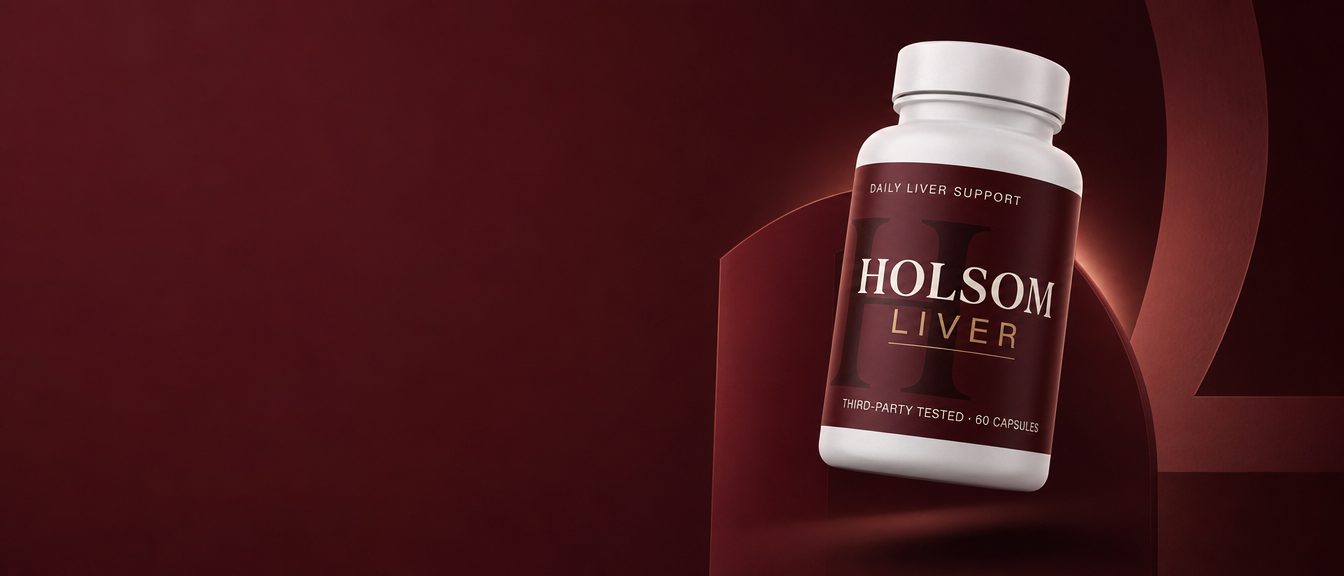
A liver supplement is not a cleanse, not a treatment, and not a fix. What it can honestly be is one small, daily way to support an organ that works every single day. That is the whole idea behind Holsom.
We built Holsom as the opposite of a cleanse. A focused daily formula, taken consistently, for the organ already doing the work. It does not claim to detox you, because your liver already does that. It does not promise a reset, because your liver does not need resetting. It is a short, deliberate formula rather than a thirty-ingredient label built to look powerful — and no single ingredient carries it. And we tell you upfront that you will not feel it working, because nobody feels their liver working, with or without a supplement.
No theater. Just daily support, honestly described. If that sounds less exciting than a weekend flush, it is. It is also the version that is actually true.
The bottom line
Your liver never needed cleansing. It has been running a sophisticated, multi-stage detoxification process your entire life, quietly, without a tea or a kit or a subscription. The smartest thing you can do is support that system with the basics, stay skeptical of anything promising a flush or a reset, and treat a supplement, if you choose one, as a small daily habit rather than a miracle.
Holsom launches soon. The full formula goes to our list first, along with a free 5-minute guide to liver health.
Frequently asked questions
Do liver detox teas work?
There is no good evidence that detox teas remove toxins from the liver or improve how it works. Your liver already handles detoxification on its own, through a multi-stage biological process a tea cannot replicate.
Can a cleanse undo a weekend of drinking?
No. Johns Hopkins is direct on this: cleanses have not been shown to undo the effects of overindulgence in food or alcohol. The only real lever is reducing the load, which mostly means drinking less.
Does the liver detox itself?
Yes. Detoxification happens in coordinated phases inside the liver and is one of its normal, continuous jobs. That is exactly why a product promising to "detox" it has the relationship backwards.
Are liver detox supplements safe?
Not always. They are not FDA regulated for safety and efficacy before sale, formulations are not standardized, and some supplements have been linked to liver injury. Talk to a healthcare professional before starting one.
What actually helps my liver, then?
The unglamorous basics: less alcohol, a reasonable weight, real food, regular movement, and screening if you have risk factors. A supplement can be a small daily part of a routine, but it is not a substitute for any of these.
Sources
- Johns Hopkins Medicine, “Detoxing Your Liver: Fact Versus Fiction”: hopkinsmedicine.org
- Telbany A, et al. “Liver Cleansing Imposters: An Analysis of Popular Online Liver Supplements.” The American Journal of Gastroenterology, January 2026.
Written by
The Holsom Team
Editorial, Holsom
We research and write everything published here, working only from primary clinical literature and guidance from major medical institutions. We name the limits of the evidence, including where it runs against our own product.
This article is for general education and is not medical advice. It is not intended to diagnose, treat, cure, or prevent any disease. Speak with a qualified healthcare professional about your own liver health.